
Artificial intelligence is no longer a futuristic concept, it is the core engine driving modern digital retail. With global e-commerce sales projected to surpass $8 trillion by 2028, customer expectations have shifted. Today’s buyers demand frictionless, highly personalized, and instant experiences across all devices.
For mid-market enterprises and growing global brands, a standard, static website is no longer sufficient. To capture international market share, businesses require dynamic architectures capable of real-time personalization, smart search, and predictive inventory scaling.
Here is how AI is fundamentally reshaping custom e-commerce website development, and how your brand can leverage it to build a faster, smarter, and more profitable digital ecosystem.
1. The Shift: Traditional vs. AI-Powered E-Commerce Website Development Architecture
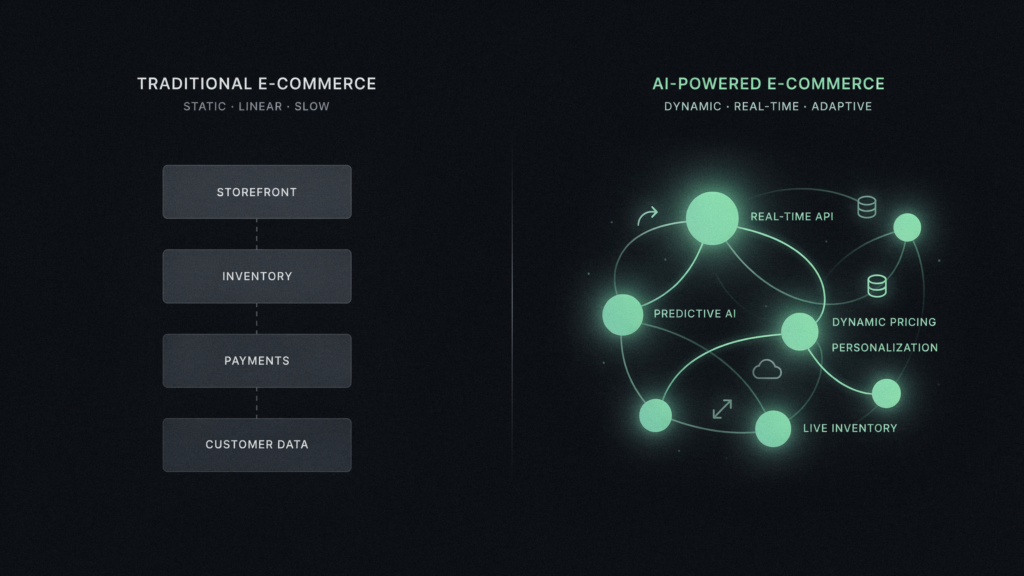
In traditional e-commerce website development, user experiences are rigid. Every visitor sees the same homepage banner, the same product grids, and the same static recommendations.
AI-powered architecture transforms this model by analyzing browsing behavior, purchase history, and global demographic data in real time to generate unique experiences for every single user.
| Feature | Traditional E-Commerce | AI-Powered E-Commerce |
| Search Functionality | Basic keyword matching (fails on typos). | Semantic & natural language search. |
| Product Recommendations | Generic “Related Products” lists. | Hyper-personalized, predictive suggestions. |
| Inventory Management | Manual planning and reactive restocking. | Predictive forecasting and automated workflows. |
| Customer Support | Static FAQ pages or manual email tickets. | 24/7 AI-driven virtual shopping assistants. |
For businesses investing in enterprise WooCommerce development, integrating AI capabilities directly into the core codebase is no longer just a feature—it is a strategic requirement for scaling cross-border revenue.
2. Driving Revenue with AI Search and Recommendations
If users cannot find a product instantly, they will bounce to a competitor. AI resolves this through advanced semantic routing and behavioral learning.
Smarter Semantic Search
Standard e-commerce search engines rely heavily on exact keyword matching. If a user misspells a word, the search returns zero results. AI-powered semantic search understands intent. If a customer searches for “comfortable shoes for office work,” the AI returns relevant formal footwear, even if those exact words are missing from the product title.
Predictive Product Recommendations
AI engines do not randomly suggest cross-sells. By analyzing thousands of data points, including real-time cart activity and seasonal buying habits, the system predicts what a user actually wants. If a customer adds a DSLR camera to their cart, the AI instantly routes custom API data to suggest compatible lenses and memory cards, effortlessly increasing the Average Order Value (AOV).
3. Operational Scale: Inventory, Automation, and Security
Enterprise e-commerce is not just about the frontend user experience; it requires heavy-duty backend engineering to manage logistics and protect consumer data.
Demand Forecasting and Inventory
Managing global stock manually is a massive operational risk. AI empowers digital platforms to anticipate inventory issues before they happen. By analyzing historical sales data and market trends, AI can automate restocking alerts and optimize warehouse supply chains, preventing both stockouts and overstocking.
Proactive Fraud Detection
As transaction volumes scale, so do cybersecurity threats. Unlike rule-based security firewalls, AI continually learns new fraud patterns. It analyzes payment risk, detects suspicious login anomalies, and blocks malicious bot traffic in real time.
4. Unifying SEO, AEO, and GEO for E-Commerce
Even the most advanced platform will fail if global customers cannot find it. AI is revolutionizing how we structure code for search visibility.
- Generative Engine Optimization (GEO): AI search assistants (like ChatGPT and Google AI Overviews) require clean, structured data. We implement advanced Schema markup to ensure these engines understand your product pricing, reviews, and inventory status instantly.
- Core Web Vitals Optimization: AI models prioritize fast, bloat-free websites. By utilizing lightweight, custom WordPress blocks instead of heavy page builders, we ensure your e-commerce platform loads in milliseconds.
- Automated Metadata Scaling: For catalogs with thousands of SKUs, AI assists in generating optimized title tags, meta descriptions, and image alt text, ensuring comprehensive SEO coverage without manual bottlenecking.
5. Future-Proofing Your Digital Storefront
The evolution of AI search and predictive commerce is moving rapidly. Early adopters who integrate these technologies into their bespoke web architecture will hold a massive competitive advantage over brands relying on outdated, template-based systems.
Future-ready e-commerce platforms must focus on:
- Headless Architecture & Clean Code
- Strict GDPR & Privacy-First Data Collection
- Cross-Border API Integrations (Klarna, Mollie, SEPA)
Scale Your Global E-Commerce Website Development Architecture with WebClyde
Building an AI-ready e-commerce platform requires deep technical discipline. You cannot rely on fragile plugins or bloated templates.
WebClyde represents a powerful evolution in web engineering. Backed by the 15-year software legacy of AM2AM Software and a global team of 120+ product experts, we architect high-conversion WooCommerce ecosystems tailored for global scale.
From bespoke API integrations to strict GDPR compliance and zero-downtime legacy migrations, we eliminate technical risk so you can focus on driving worldwide revenue.
[ Book a Technical Strategy Consultation ]
Frequently Asked Questions (FAQ)
Q1. How is AI used in custom e-commerce development?
AI is engineered into the platform’s core to power semantic search, predictive product recommendations, dynamic pricing, automated inventory forecasting, and real-time fraud detection.
Q2. Does AI replace the need for custom web developers?
No. While AI assists with data processing, you still require elite software engineers to architect the database, execute complex API integrations, ensure GDPR data privacy, and maintain a secure, zero-bloat codebase.
Q3. Can AI secure an e-commerce website?
Yes. Integrated AI security protocols actively monitor for suspicious login attempts, bot attacks, and payment anomalies, stopping fraudulent transactions in real time before they damage your business.
Q4. How does custom WooCommerce development handle global scale?
We architect bespoke WooCommerce environments featuring native multi-currency routing and localized European payment gateways (Klarna, Mollie, SEPA) to ensure frictionless cross-border trade without performance lag.